I’ve been playing with both the Amazon CloudFront and Rackspace Cloud Files CDNs over the past week with the eventual aim of offloading all the static files that make up this site (all like 4 of them) to a CDN, mainly for the fun of it.
Having used Amazon’s S3 storage service for quite a while now they were my first choice, but I didn’t want to totally discount the Rackspace offering – they’ve done some seriously cool things in a very short period of time and I swear by their Cloud Servers.
From casually playing around there have only been minor differences. First of all Cloud Files doesn’t seem to support “folders”, so you end up with a much flatter storage pool. For my 4 files that’s really only an issue for my OCD, but Amazon does support hierarchical directory structures, so that’s something to keep in mind.
Otherwise I found Amazon’s system only slightly more annoying in the way you ‘deploy’ an S3 bucket to the CloudFront CDN. It seemed to take slightly longer and emphasize the idea that there were two distinct systems and products being used, whereas Cloud Files seems much more unified – click a check box and you’ve got a CDN URL.
So with one minor annoyance on each side of the aisle I turned to hard quantifiable data, something every programmer loves. I loaded up my stylesheet on both CDNs and pointed a Pingdom check at each. The results were surprising.
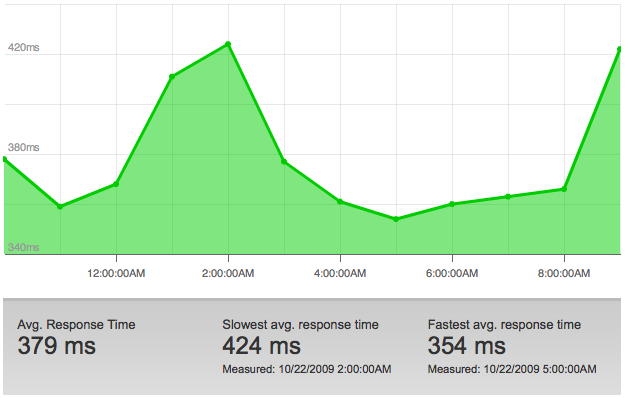
After 24 hours of monitoring the Cloud Files average response time was one tenth that of Amazon CloudFront’s and its slowest response time was still 40% faster than CloudFront’s average.
Just to make sure it wasn’t a fluke, I setup another set of Pingdom checks to measure performance of a binary image file:
In short, after the initial delay as the file was propagated throughout the CDN network, Rackspace kicked Amazon’s ass.
I know who’ll be getting my CDN business…


[...] Click here to see his results. [...]
[...] This post was mentioned on Twitter by Jonathan Ellis and esayegh, Chris Meller. Chris Meller said: found some surprising results comparing the performance of cloudfiles and cloudfront: http://is.gd/4wCnj (spoiler: @rackcloud rules) [...]
Nice, I also used Amazon until I learned that Cloudfiles was reselling Limelight Networks. I switched and was absolutely impressed by Limelight’s performance. I asked for my website viewers to provide feedback on the performance after the switch and had about 4,000 replies with 99.7% voting for SIGNIFICANT performance improvement of my site in general after I switched to Cloudfiles from Amazon.
I’m a happy camper.
[...] Twitter 上看到這篇關於 Amazon CloudFront 與 Rackspace Cloud Files CDN 的比較文章:「Amazon CloudFront vs. Rackspace Cloud Files CDN Performance」,先講重點,Rackspace Cloud Files CDN 不是自己建立 CDN 平台,而是使用 [...]
I second that. I ran a few tests only a couple of days back on cloudfront and found no significant difference between s3 and cloudfront (was trying to compare serving from s3 vs cloudfront). both of them were serving files from US (I’m in India). Even after 24 hrs, cloudfront hasn’t gone to serving from a nearer hong kong location. not so sure what’s going on but amazon’s offering does seem to be iffy right now.
For a few days I had actually served the site’s static files from CloudFront. Its lack-luster performance is what made me decide to gather some real statistics.
Looking back at my Account Activity page, some of those requests were definitely serving from different locations on their network. I was charged a premium for requests serviced through the EU, Japan, and Hong Kong.
Too bad it didn’t seem to help.
With a CDN, everything depends on where you are and where is the nearest CDN front end.
So your mileage quite obviously varies with location.
To compare 2 CDNS, you need to check them from many places, or your result is valid only for you and your neighbors, at the time of the test.
Of course CDN comparison depends on your location, but with aggregate results like this even a worst-case scenario in a single location can’t be too bad.
Pingdom also reports response times every time they check by individual (global) location. I considered including those details but decided it wasn’t necessary since there weren’t any surprises.
[...] out Chris Meller’s post on Amazon CloudFront vs. Rackspace Cloud Files CDN Performance. Not only does he give a reasonable assessment, he also uses Pingdom.com for his analysis — and [...]
Cloud Files doesn’t support hierarchical folders, but it does support path names. You can create a file named ‘css/mainpage/style.css’ (with slashes in the filename), which will show up as /css/mainpage/style.css on the CDN.
It’s not quite the same as a hierarchy, but it does make for prettier URLs.
Thanks for the tip, Dan! I hadn’t seen that mentioned anywhere…
Nice graphs from Gomez included… I would ask that the info be clarified – it appears you are comparing LLNW’s global footprint to Amazon’s US cloudfront network. Apples to an orange…
How about some graphs comparing Internap, Edgecast, CDNetworks or others against LLNW’s network.. Also – Cotendo seems to have a very nifty product set – and performance is smoking quick…
Look forward to the response -
The list of Pingdom servers that monitors checks on my account includes boxes in the US, Germany, England, the Netherlands, Canada, and Sweden.
Notably none in Asia or the Pacific area, but it’s certainly not just checking the US network. See my reply a few comments up about being charged for requests serviced through the EU, Hong Kong, and Japan.
If I had the ability to accurately (and cheaply) compare all those other networks I would gladly do so… But I don’t. My goal was only to compare the two leaders in the ala carte CDN business.
Hi JB,
I can setup a trial account on EdgeCast for you. Just let me know if you are interested.
Thanks,
Maykel
Have you seen the OpSourceCloud?
OpSource still offers the best solution for Serious SaaS companies to deliver a production application. (customers, Adobe, Taleo, Xactly, SAP, and 100s more)
We now offer a more cost effective and flexible cloud alternative built with enterprise needs in mind.
if you want to check it out, RLE01 = 20% off.
Chris-
I appreciate the comparison you have here, as I’m currently evaluating these two products for a client.
My only concern with this test is that I would have liked to see some throughput numbers (as this client will be streaming large video files from the CDN).
Any anecdotes worth mentioning on this front?
@Matt
Are you kidding? Do you really need to see throughput numbers on a blog comparing Cloudfiles to Amazon? You’re “client” should probably be looking for someone else to handle their business.
Anybody with an ounce of knowledge on CDN’s knows there would be no comparison. Limelight will be far superior to Amazon for throughput in 99% of cases. And not just a little better they will totally destroy Amazon in that testing.
This is great information. We are currently in the process of choosing a hosting and CDN partner for our own business as well as all of our customer sites — this definitely helps us solidify our decision to use Rackspace and Limelight for hosting and CDN. Thanks!
Hi Chris,
I’ve got similar results in our comparison of CloudFront and EdgeCast, but in our tests the response times of CloudFront were around 150ms average, may I ask what’s the size of the file you were testing? We tested with a 55KB file (jquery.js). I can setup a trial account for you if you want to do some tests, you don’t even need storage since you can use S3 or your own servers as origin storage.
Thanks,
Maykel
[...] We actually run across a blog for a user of both Cloud Files and CloudFront that wanted to check performance between the two services and graphed everything out for you. You can find his blog at http://chrismeller.com/2009/10/amazon-cloudfront-vs-rackspace-cloudfiles-cdn-performance/#more-642. [...]
[...] Amazon CloudFront vs. Rackspace Cloud Files CDN Performance [...]
[...] Chrome, an OS that already runs exclusively in the cloud. Rackspace is largely viewed as a major threat to Amazon’s cloud superiority and an acquisition could finally provide Google with the [...]